

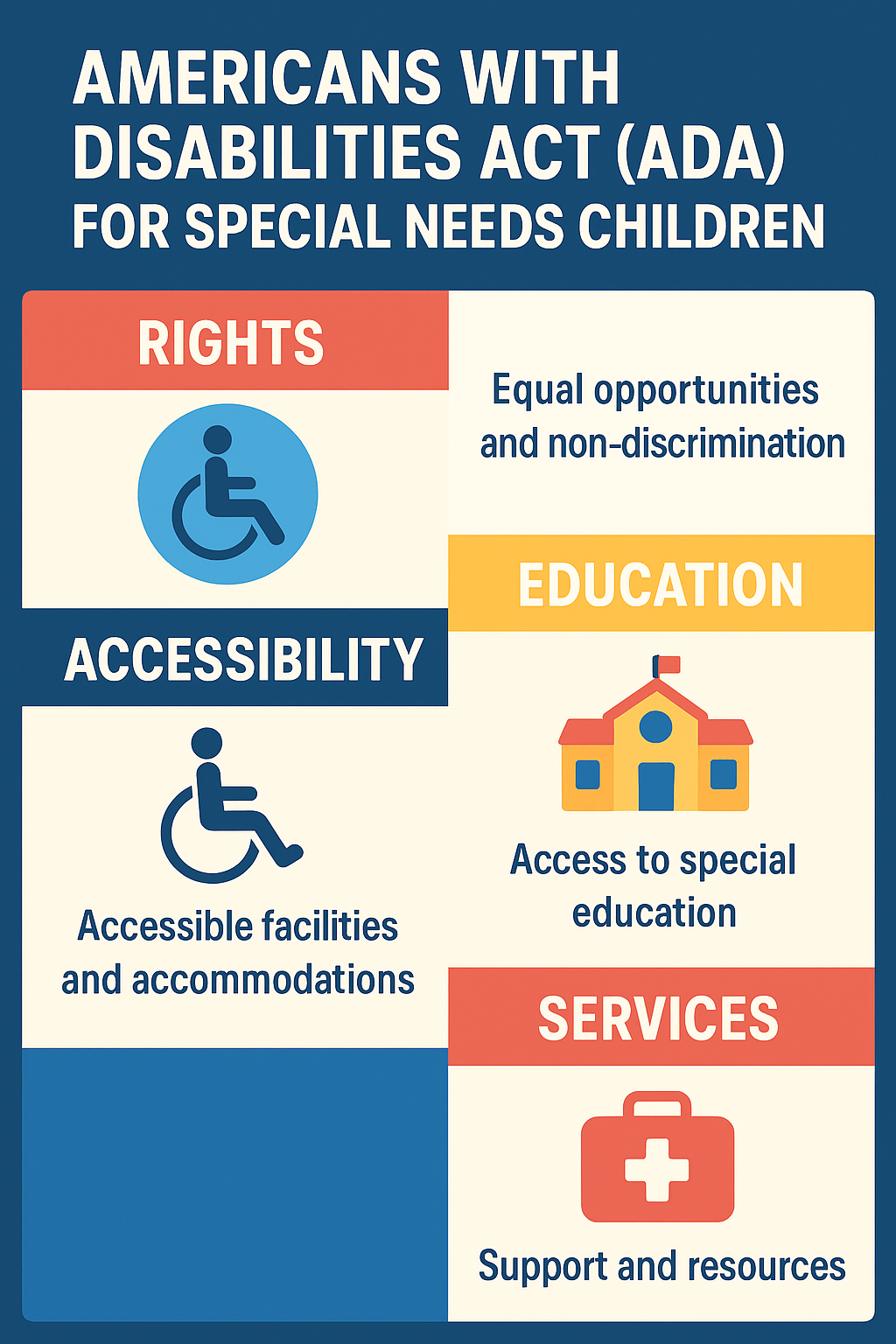
🌟 Unlocking Rights: A Parent’s Deep Dive into the Americans with Disabilities Act (ADA) for Special Needs Children 🌈
The Americans with Disabilities Act (ADA Act) is more than just a piece of legislation; it’s a foundation of equal opportunity and civil rights for people with disabilities across the United States. For parents of special needs children, understanding the Americans with Disabilities Act—specifically what the ADA mean and how its provisions apply to their child’s life—is a critical step toward advocacy and empowerment.
This in-depth guide cuts through the complexity to give you actionable insights, real-world examples, and the deep research you need to ensure your child enjoys full ADA compliance in every facet of public life. We’ll explore the essence of the Americans with Disabilities Act, the meaning of ADA handicap protections, and how this landmark law champions inclusion for those with disabilities.

- The Foundation: What Exactly Does the Americans with Disabilities Act Mean?
- 🏛️ Deciphering the Titles: The Five Pillars of the ADA Act
- 📊 The Landscape of Need: Statistics on Children with Disabilities
- 💡 Deep Insights About ADA and Children
- 📝 A Personal Process/Experience: Navigating ADA Compliance at a Local Pool
- 🛠️ Achieving Full Americans with Disabilities Act Compliance: A Checklist for Parents
- 🗣️ Americans with Disabilities Act FAQs
- ❓ FAQ 1: How does the Americans with Disabilities Act protect my child in a private preschool?
- ❓ FAQ 2: What is the main difference between an IEP and an ADA 504 Plan for my child's services?
- ❓ FAQ 3: What does ADA mean when it refers to an ADA handicap?
- ❓ FAQ 4: How can I file an Americans with Disabilities Act compliance complaint?
- 🚀 The Future of the Americans with Disabilities Act and Digital Inclusion
- 🔗 Sources
The Foundation: What Exactly Does the Americans with Disabilities Act Mean?
The Americans with Disabilities Act (often just called the ADA) is a comprehensive civil rights law passed in 1990 that prohibits discrimination against individuals with Americans with Disabilities Act disabilities in all areas of public life. Its goal is simple: to ensure that people with disabilities act as equal participants in society, with the same opportunities as everyone else.
This law is a powerful ally for parents, extending protections well beyond the classroom (which is often covered by the IDEA, the Individuals with Disabilities Education Act). The ADA act governs accessibility in public spaces, private businesses, transportation, and state and local government services, all crucial components of your child’s daily life.
The Two Laws You Need to Know: ADA vs. IDEA
While both the Americans with Disabilities Act and the IDEA protect children, they serve different primary functions.
- IDEA (Individuals with Disabilities Education Act): Focuses specifically on education. It guarantees a Free Appropriate Public Education (FAPE) and the right to an Individualized Education Program (IEP) for eligible students. IDEA’s primary tool is the provision of specialized instruction and related services.
- ADA (Americans with Disabilities Act): Focuses on non-discrimination and equal access to the community. It ensures that schools, parks, doctor’s offices, restaurants, and transportation are accessible and that reasonable modifications are made. The ADA’s primary tool is removing barriers and ensuring equal opportunity.
Both laws are vital, and in many situations, they work together to ensure a special needs child’s rights are fully protected.
🏛️ Deciphering the Titles: The Five Pillars of the ADA Act
To truly understand how to advocate for your child under the Americans with Disabilities Act, you must know its structure. The law is divided into five “Titles,” each addressing a different area of public life.
1. Title II: Public Services & Your Child’s Community Access (The Most Relevant)
Title II is arguably the most critical for children with disabilities act protections outside of employment. This title applies to state and local government entities, including:
- Public Schools (in addition to IDEA)
- Public Transportation (buses, trains)
- Parks and Recreation Centers
- Public Libraries
- Local Government Programs (e.g., summer camps, after-school care run by the city/county)
Key Requirement: State and local government programs must provide people with Americans with Disabilities Act disabilities an equal opportunity to benefit from all their services, programs, and activities. This requires reasonable modifications to policies and ensuring programs are physically accessible.
2. Title III: Public Accommodations & The Private Sector
Title III of the ADA act governs private businesses that are open to the public, known as “public accommodations.” This includes:
- Restaurants and Retail Stores
- Private Schools and Daycare Centers
- Doctor’s Offices and Hospitals
- Movie Theaters and Museums
- Hotels and Gyms
Key Requirement: These entities must not discriminate and must make reasonable modifications to their policies, practices, or procedures to serve people with Americans with Disabilities Act disabilities. They must also remove architectural barriers (like stairs or narrow doors) where it is readily achievable to do so.
Example of Real Results: A child with severe food allergies was denied admission to a private summer camp. The parents cited Title III of the Americans with Disabilities Act, arguing the camp’s policy of “no outside food allowed” was discriminatory. The camp, to achieve ADA compliance, was required to make a reasonable modification to their policy, allowing the child to bring their specific, safe meals.
📊 The Landscape of Need: Statistics on Children with Disabilities
Understanding the scope of the community highlights the immense importance of the Americans with Disabilities Act. The following data underscores why strict ADA compliance and support for Americans with Disabilities Act disabilities are crucial for our society’s youngest citizens.
| Disability Data Point (Children in the U.S.) | Statistic | Source | Source URL |
|---|---|---|---|
| Students Receiving Special Education Services (Ages 3–21) | 7.5 Million (15% of all public school students) | NCES (National Center for Education Statistics) | https://nces.ed.gov/fastfacts/display.asp?id=64 |
| Most Common Disability Category (IDEA) | Specific Learning Disabilities (32%) | NCES (National Center for Education Statistics) | https://nces.ed.gov/programs/coe/pdf/2023/cgg_508.pdf |
| Children with Special Health Care Needs (Approximate) | 1 in 5 (over 14.5 million) | National Survey of Children’s Health (NSCH) | https://www.census.gov/programs-surveys/nsch.html |
| Children with a Developmental Disability (Approximate) | 1 in 6 | CDC (Centers for Disease Control and Prevention) | https://www.cdc.gov/child-development/about/developmental-disability-basics.html |
💡 Deep Insights About ADA and Children
Most discussions of the Americans with Disabilities Act focus on physical access for adults. For a special needs child’s family, the deepest advocacy challenges lie in nuances of interpretation and integration.
The Nuance of “Auxiliary Aids and Services”
Beyond ramps and accessible parking (ADA handicap standards), the ADA act mandates effective communication. For a child with disabilities act protections, this can mean:
- For a child with hearing loss: Providing a sign language interpreter during a public library story time or an assistive listening device at a city-run theater.
- For a child with low vision: Providing large-print menus at a restaurant or a screen-reading program for a park district computer lab.
- For a non-verbal child: Accepting communication via an Augmentative and Alternative Communication (AAC) device as effective communication.
Expert Knowledge: A common mistake by public places is assuming a parent or sibling can translate for the child. While that is often helpful, if a child is d/Deaf, the ADA compliance requirement is for a qualified interpreter, not a family member, to ensure truly effective communication.
The Hidden Power of the “Association Provision”
The Americans with Disabilities Act protects not just the person with disabilities act rights, but also those who are related or associated with disabilities act individuals.
- What this means for you: A private daycare cannot refuse to hire you as a teacher because your child has a severe disability and the management worries you’ll need too much time off. Discrimination based on your association with a person with disabilities act is illegal under the ADA.
The Service Animal Distinction
Service animals are protected under the Americans with Disabilities Act. This is vital for children who rely on a service animal for balance, alerting to medical episodes (like seizures or low blood sugar), or emotional support related to a psychiatric disability.
- Crucial Fact: A service animal must be permitted in any place of public accommodation where the child is allowed. Questions are limited to: (1) Is the dog a service animal required because of a disability? and (2) What work or task has the dog been trained to perform? You cannot be asked about the nature of your child’s Americans with Disabilities Act disabilities.
📝 A Personal Process/Experience: Navigating ADA Compliance at a Local Pool
My son, Leo, has an intellectual disability and severe sensory processing disorder. We discovered the challenge of ADA compliance not in a classroom, but at our local, city-run community pool (covered by Title II of the Americans with Disabilities Act).
The Challenge
Leo loves the water, but the standard public swim session was overwhelming: loud whistles, splashing, and sudden crowds. The pool had a mandatory “buddy system” rule: all children under 12 needed an adult in the water within arm’s reach. For a sensory-sensitive child like Leo, a restrictive arm’s reach was a meltdown trigger, but being alone was unsafe. The rule, while well-intentioned for safety, was a policy barrier that prevented his equal participation.
The Advocacy Process
- Identify the Barrier: The rigid “within arm’s reach” policy was the barrier. It was a failure of ADA compliance because it didn’t allow for a reasonable modification for a child with disabilities act protections.
- Request a Modification: I approached the pool manager and cited Title II of the Americans with Disabilities Act, explaining that the policy needed a reasonable modification due to Leo’s Americans with Disabilities Act disabilities.
- Proposing a Solution: We proposed a modified rule: Leo would wear a highly visible red rash guard and a US Coast Guard-approved flotation vest. The “buddy” (me) would remain poolside in the shallow end, within 10 feet, allowing him freedom of movement while ensuring safety—a solution that did not fundamentally alter the program (the safety rule) but accommodated his need for space.
- The Result: After a brief negotiation, the manager agreed. The pool created an “ADA Exception Log” for Leo’s accommodations. This was a direct result of leveraging the Americans with Disabilities Act to ensure access.
- This experience taught me that ADA compliance often requires proactive communication and proposing solutions that meet both the child’s needs and the organization’s safety objectives.
🛠️ Achieving Full Americans with Disabilities Act Compliance: A Checklist for Parents
As an advocate for your child with disabilities act rights, you need a proactive checklist. This helps move the concept of the Americans with Disabilities Act from law to daily reality.
The Parent’s ADA Compliance Checklist
| Area of Life | ADA Title | Actionable Step for Compliance |
|---|---|---|
| Daycare/Private School | Title III | Ensure staff training on your child’s specific needs, request reasonable modifications to strict disciplinary policies. |
| Recreational Activities (Private) | Title III | Ensure soccer leagues, art classes, etc., allow for modifications (e.g., a quiet space, use of a sensory toy). |
| Public Parks/Playgrounds | Title II | Verify the playground meets current ADA handicap standards (ramps, accessible surfacing, transfer systems). |
| Public Transit/School Bus | Title II | Confirm that lifts, ramps, and tie-downs for wheelchairs are functional and used correctly. |
| Medical/Dental Offices | Title III | Request effective communication (e.g., written instructions for a non-verbal child) and physical access (accessible exam tables). |
🗣️ Americans with Disabilities Act FAQs
This section addresses common, long-tail search queries about the Americans with Disabilities Act for families.
❓ FAQ 1: How does the Americans with Disabilities Act protect my child in a private preschool?
The Americans with Disabilities Act protects your child in a private preschool under Title III as a place of public accommodation. This means the school cannot discriminate against your child based on their Americans with Disabilities Act disabilities. Specifically, the school must provide reasonable modifications to its policies, practices, or procedures unless doing so would fundamentally alter the nature of the program or result in undue burden. For example, they must typically allow a child to bring a service animal or modify a naptime routine for a child with specific sleep needs.
❓ FAQ 2: What is the main difference between an IEP and an ADA 504 Plan for my child’s services?
The main difference is what they provide: An IEP (under IDEA) provides specialized instruction and related educational services, aiming for educational benefit. A 504 Plan (under the Americans with Disabilities Act and Section 504 of the Rehabilitation Act) provides accommodations and modifications to ensure equal access to the general education environment. An IEP is for students who require special education; a 504 Plan is for students with disabilities act protections who need accommodations but not specialized instruction.
❓ FAQ 3: What does ADA mean when it refers to an ADA handicap?
When people ask what ADA mean in reference to ADA handicap—the modern, official term used within the Americans with Disabilities Act is simply disability. The law defines an individual with disabilities act protections as a person who:
- Has a physical or mental impairment that substantially limits one or more major life activities (like walking, learning, breathing, concentrating).
- Has a record of such an impairment.
- Is regarded as having such an impairment.
The term ADA handicap is a legacy term, but the protection remains the same: ensuring equal access and non-discrimination.
❓ FAQ 4: How can I file an Americans with Disabilities Act compliance complaint?
To file an Americans with Disabilities Act compliance complaint for a special needs child, you typically use the U.S. Department of Justice (DOJ) for issues related to Title II (State/Local Government) and Title III (Public Accommodations). You can submit a written complaint detailing the discriminatory event, which specific Americans with Disabilities Act disabilities your child has, and how the entity failed to meet ADA compliance by denying access or refusing a reasonable modification.
🚀 The Future of the Americans with Disabilities Act and Digital Inclusion
As we look toward 2025 and beyond, ADA compliance is rapidly evolving in the digital space. The Americans with Disabilities Act was written before the internet was a daily utility, but its principles of equal access apply directly to the digital world, impacting your child’s educational and recreational opportunities.
- Website and App Accessibility: Title III of the ADA act is now broadly interpreted to cover the websites and mobile applications of public accommodations (like online stores, streaming services, and private schools). Your child with disabilities act protections has the right to access these digital resources, meaning the content must be compatible with screen readers, offer keyboard navigation, and include captions for video.
- Virtual Learning: Post-pandemic, virtual learning environments are common. These environments, if provided by a public entity (Title II), must adhere to strict Americans with Disabilities Act compliance standards to ensure all students with disabilities act as full participants.
Deep Insight: Always check for a private entity’s Accessibility Statement on their website. The absence of one can sometimes signal a lack of commitment to digital ADA compliance.
🔗 Sources
- U.S. Department of Justice (DOJ): Official ADA Homepage (For filing Title II & III complaints and access to regulations.)
- ADA National Network: Comprehensive ADA Information and Assistance (For technical assistance and guidance on ADA handicap and disability definitions.)
- U.S. Access Board: ADA Accessibility Guidelines (Detailed specifications for physical ADA compliance in design and construction.)


