

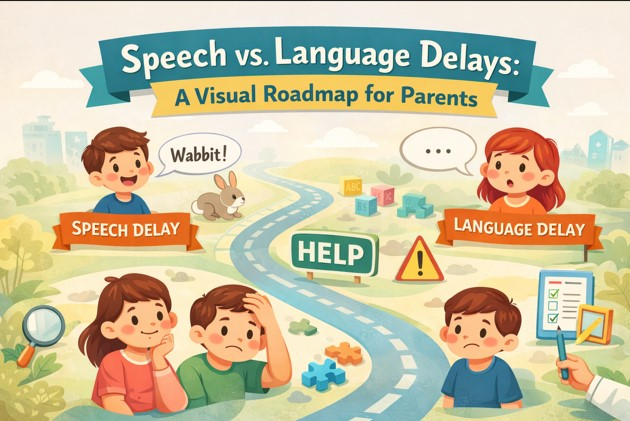
🧠 Speech vs. Language Delays: A Visual Roadmap for Parents
A Research-Backed Parent Guide to Early Discovery, Diagnosis & Intervention
🌱 Why This Guide Matters for Parents
If you are here, you likely asked yourself one of these questions:
- “Why isn’t my child talking yet?”
- “Is this a speech delay or a language delay?”
- “Should I wait or seek early intervention now?”
You are not alone ❤️
Communication delays are one of the most common developmental concerns in early childhood development, yet also one of the most misunderstood.
This visual roadmap will help you:
- Clearly understand speech vs language delays
- Identify early warning signs most websites skip
- Prepare for doctor and therapist appointments
- Make confident decisions about early intervention
🧩 Speech vs Language Delays (Simple Explanation)
🗣️ What Is a Speech Delay?
A speech delay affects how words sound.
It includes challenges with:
- Pronunciation
- Sound clarity
- Fluency
- Voice quality
🧠 The child knows what they want to say — but cannot say it clearly.
📚 What Is a Language Delay?
A language delay affects understanding and using words meaningfully.
It includes difficulties with:
- Vocabulary
- Sentence formation
- Understanding instructions
- Expressing ideas
🧠 The child may struggle to understand language, express thoughts, or both.
📊 Visual Comparison: Speech vs Language Delays
| Area | Speech Delay | Language Delay |
|---|---|---|
| Core issue | Sounds & pronunciation | Understanding & meaning |
| Child understands others | ✅ Usually yes | ❌ Often limited |
| Vocabulary | Age-appropriate | Below expected |
| Sentence formation | Normal | Delayed |
| Example | “Wabbit” for “Rabbit” | Uses only single words at age 3 |
| Therapy type | Speech therapy | Language therapy |
👉 Key insight:
Many children experience both speech and language delays together, which is why early professional evaluation matters.

📈 Real Statistics Parents Should Know
| Statistic | Data | Source |
|---|---|---|
| Children with communication disorders | ~1 in 12 (ages 3–17) | https://www.cdc.gov/nchs |
| Late talkers at age 2 | ~15–20% of toddlers | https://www.asha.org |
| Children who outgrow delays without therapy | Less than 50% | https://www.asha.org |
| Brain plasticity peak for language | Before age 5 | https://www.who.int |
| Early intervention improves outcomes | Up to 70% better communication gains | https://www.cdc.gov |
📌 Why this matters:
Waiting to “see what happens” often delays progress during the most critical brain development window.
🧠 Speech and Language Milestones (0–5 Years)
👶 12–18 Months
- Uses gestures (pointing, waving)
- Says 5–10 words
- Understands simple commands
🧒 2 Years
- Uses 50+ words
- Combines 2 words (“want milk”)
- Follows 2-step directions
🧑🦱 3 Years
- 200+ words
- Speaks in short sentences
- Understandable to familiar listeners
🧑 4–5 Years
- Clear speech
- Tells simple stories
- Understands “why” questions
🚩 Red flags appear when milestones are consistently missed, not delayed by weeks.
🚨 Early Warning Signs Parents Often Miss
Possible Speech Delay
- Speech hard to understand after age 3
- Persistent sound errors
- Avoids speaking
Possible Language Delay
- Limited eye contact with communication
- Doesn’t follow instructions
- Rarely combines words
⚠️ Important:
Behavior issues often mask communication frustration, not defiance.

🏥 The Diagnosis Lab: What Happens During Evaluation?
Step 1: Pediatric Screening
- Developmental questionnaires
- Hearing screening
Step 2: Speech-Language Pathology Evaluation
- Receptive language testingreceptive language
- Expressive language testing
- Speech sound assessment
Step 3: Rule-Outs
- Hearing loss
- Autism spectrum conditionsatio
- Neurological factors
🔍 Diagnosis is not labeling — it’s a roadmap.
🧪 How to Prepare for the Doctor or Therapist Visit
Bring this checklist 📝:
- Videos of your child communicating
- List of words they use
- Pregnancy & birth history
- Family history of developmental delays
💡 Parents are the most accurate observers of child communication development.
🧑⚕️ Speech Therapy vs Language Therapy
| Therapy Type | Focus | Who Benefits |
|---|---|---|
| Speech Therapy | Sounds & clarity | Speech delay |
| Language Therapy | Understanding & expression | Language delay |
| Pediatric Speech Therapy | Play-based combined approach | Toddlers & preschoolers |
🔗 Learn more:
https://www.asha.org/public/speech/development/
🌟 Real Parent Experience (Composite Story)
“At 2.5 years, my son only said 10 words. Everyone told me to wait. After pediatric speech therapy, he now speaks in sentences at 4. Early intervention changed our lives.”
✨ Early action reduces long-term academic and emotional struggles.
🧠 Why Early Intervention Works
- Brain pathways are most flexible before age 5
- Language input builds neural connections
- Therapy trains both child and parent strategies
📌 Missed opportunity = lost neural potential
🔗 https://www.cdc.gov/ncbddd/actearly
🎯 Practical At-Home Strategies Parents Can Start Today
- Narrate daily routines
- Expand child’s words (“ball” → “big red ball”)
- Pause to encourage response
- Use visual supports
⚠️ These support, not replace, professional therapy.

❓ FAQs (Voice Search & Long-Tail Optimized)
Is speech delay the same as language delay?
No. Speech vs language delays affect different communication systems, though they can overlap.
Can a child have a language delay without speech issues?
Yes. Some children speak clearly but struggle with understanding or sentence structure.
When should parents seek help?
If milestones are missed by 6 months or more, seek evaluation immediately.
Does bilingualism cause language delay?
No. Research shows bilingual children develop language at comparable rates.
🔗 https://www.asha.org/public/speech/development/bilingual/
🧩 What Other Websites Miss (Expert Insight)
- Emotional regulation issues often stem from communication frustration
- Delays impact literacy and social skills, not just speech
- Parent involvement predicts therapy success more than frequency alone
🏁 Final Takeaway for Parents ❤️
Understanding speech vs language delays early gives your child the best possible start.
You are not overreacting.
You are advocating.
Early knowledge leads to early action — and early action changes futures 🌈
🔗 Authoritative External Resources
- CDC Developmental Milestones: https://www.cdc.gov/ncbddd/childdevelopment
- American Speech-Language-Hearing Association: https://www.asha.org
- World Health Organization (Child Development): https://www.who.int


