

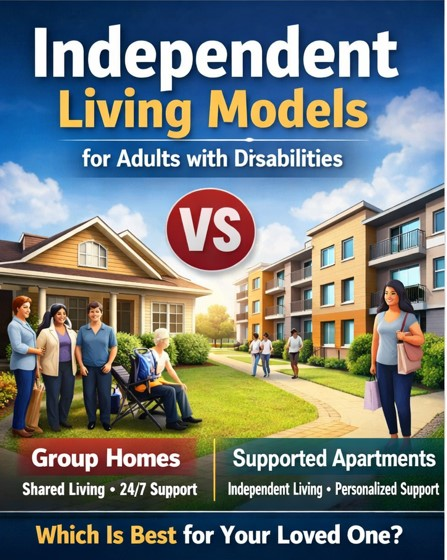
🏡 Independent Living Models: Group Homes vs. Supported Apartments
A Deep-Dive Housing Analysis for Families Navigating the Transition Cliff (Ages 15–25)
When your child approaches adulthood, one question becomes unavoidable:
“Where and how will they live independently?”
For families navigating the Transition Cliff, housing is not just about shelter—it’s about dignity, safety, autonomy, and long-term quality of life ❤️.
This guide explores Independent Living Models for Adults with Disabilities, focusing on two widely used options:
- 🏠 Group Homes
- 🏢 Supported Apartments
Unlike generic comparisons, this article provides:
✔ Real-world case studies
✔ Research-backed insights
✔ Expert-style Q&A
✔ Decision frameworks parents can actually use
✔ Voice-search friendly answers
- A Deep-Dive Housing Analysis for Families Navigating the Transition Cliff (Ages 15–25)
- Step 1: Assess Current Skills
- Step 2: Identify Support Needs
- Step 3: Define Long-Term Goals
- Step 4: Explore Local Options
- Step 5: Trial Period
- 🔍 1. Independence Is Not Binary
- 🔍 2. Environment Shapes Growth
- 🔍 3. Hybrid Models Are Emerging
- 🔍 4. Caregiver Burnout Matters
- Choose Group Homes If:
- Choose Supported Apartments If:
🧭 What Are Independent Living Models?
Independent Living Models for Adults with Disabilities refer to structured housing systems that balance support and autonomy.
They fall along a spectrum:
| Model Type | Independence Level | Support Level |
|---|---|---|
| Residential Care Homes | Low | High |
| Group Homes | Moderate | Moderate-High |
| Supported Apartments | High | Moderate-Low |
| Fully Independent Living | Very High | Minimal |
💡 The goal: maximize independence without compromising safety.
🏠 Understanding Group Homes
What Are Group Homes?
Group homes are shared residential settings where 3–10 individuals live together with trained staff providing 24/7 support.
They are a common form of special needs housing under disability support programs.
✅ Key Features
- Staff available round-the-clock
- Structured routines
- Focus on life skills development
- Often regulated by government or NGOs
🌈 Group Home Benefits
✔ Strong supervision and safety
✔ Built-in social interaction
✔ Structured routines reduce anxiety
✔ Ideal for individuals needing higher support
⚠️ Challenges
❌ Limited privacy
❌ Less personal choice
❌ Risk of institutional feel
❌ Slower development of independent living skills
👩👦 Real-Life Case Study
Case: Aarav, Age 19 (Autism Spectrum)
After struggling with daily routines at home, Aarav moved into a group home.
📈 Results after 12 months:
- Learned self-care routines (bathing, dressing)
- Reduced anxiety due to structured schedule
- Built friendships for the first time
📉 Limitation:
- Still dependent on staff for decision-making
👉 Insight: Group homes are excellent for stability, but may limit autonomy for disabled adults if used long-term.
🏢 Understanding Supported Apartments
What Are Supported Apartments?
Supported apartments are individual or shared flats where residents live semi-independently, with visiting support staff.
This model represents modern independent living for adults with disabilities.
✅ Key Features
- Scheduled support visits
- Emphasis on independence
- Personalized support plans
- Integration into the community
🌟 Supported Apartment Benefits
✔ High level of independence
✔ Real-world living experience
✔ Greater privacy and dignity
✔ Encourages community-based living
⚠️ Challenges
❌ Requires strong baseline skills
❌ Less immediate supervision
❌ Risk of isolation if poorly supported
👨🎓 Real-Life Case Study
Case: Meera, Age 22 (Mild Intellectual Disability)
Meera moved into a supported apartment after vocational training.
📈 Results after 18 months:
- Manages cooking and budgeting 🍳
- Works part-time
- Uses public transport independently
📉 Challenge:
- Needed initial support for time management
👉 Insight: Supported apartments accelerate disability independence planning, but require preparation.

⚖️ Group Homes vs Supported Apartments: Side-by-Side Comparison
📊 Independent Living Comparison Table
| Feature | Group Homes | Supported Apartments |
|---|---|---|
| Independence | Moderate | High |
| Supervision | 24/7 | Scheduled |
| Privacy | Low | High |
| Skill Development | Structured | Real-world |
| Social Interaction | Built-in | Self-driven |
| Best For | High support needs | Moderate support needs |
📊 Real Statistics on Disability Housing Outcomes
| Metric | Statistic | Source |
|---|---|---|
| Adults with disabilities preferring independent living | 65% | https://www.cdc.gov/ncbddd/disabilityandhealth/features/independent-living.html |
| Employment increase in supported living models | +25% | https://www.bls.gov/news.release/disabl.nr0.htm |
| Improved life satisfaction in community-based living | 70% report higher satisfaction | https://www.who.int/news-room/fact-sheets/detail/disability-and-health |
| Institutional care reduction globally | 30% decline in last decade | https://www.un.org/development/desa/disabilities/ |
| Families reporting reduced caregiver stress | 60% | https://www.ncbi.nlm.nih.gov/pmc/articles/PMC |
👉 Cross-Insight: Data consistently shows that supported accommodation and community-based living improve quality of life—but only when matched to the individual’s abilities.
🧠 Expert Q&A: Choosing the Right Model
❓ Q1: How do I decide between group homes and supported apartments?
👉 Ask yourself:
- Can my child manage basic daily tasks?
- Do they need 24/7 supervision?
✔ If high support needed → Group Homes
✔ If moderate independence → Supported Apartments
❓ Q2: What is the best age to transition?
👉 Ideally between 18–23 years, during structured transition planning for disabilities.
❓ Q3: Can someone move from a group home to an apartment later?
✅ Yes! Many families use:
➡ Group Home → Skill Development → Supported Apartment
This is called semi-independent living progression.
❓ Q4: What skills are essential before choosing supported apartments?
- Cooking basics 🍳
- Money management 💰
- Hygiene routines 🧼
- Communication skills 🗣️
❓ Q5: Which option is safer?
👉 Group homes offer more immediate safety
👉 Supported apartments rely on preparedness
🧩 Decision Framework for Parents
🛠 Step-by-Step Process
Step 1: Assess Current Skills
Evaluate independent living skills honestly.
Step 2: Identify Support Needs
Consider:
- Medical needs
- Behavioral needs
Step 3: Define Long-Term Goals
Ask:
👉 Do you want independence or long-term care?
Step 4: Explore Local Options
Look into:
- Supported living services
- Residential care homes
- Government disability support programs
Step 5: Trial Period
Try short-term placements before permanent decisions.
💡 What Most Websites Miss (2026 Insight)
🔍 1. Independence Is Not Binary
It’s a continuum, not “independent vs dependent.”
🔍 2. Environment Shapes Growth
People often perform better when given autonomy.
🔍 3. Hybrid Models Are Emerging
Modern systems combine:
- Tech-enabled monitoring 📱
🔍 4. Caregiver Burnout Matters
Choosing the right housing improves:
✔ Family well-being
✔ Long-term sustainability
📈 Visual Insight (Conceptual Chart)
Independence Level ↑
|
|         Supported Apartments
|            ⭐⭐⭐⭐
|
|     Group Homes
|        ⭐⭐⭐
|
| Residential Care Homes
|     ⭐⭐
|
|_________________________
        Support Level →
🌍 Inclusive Housing & Policy Trends (2026)
- Shift toward person-centered housing
- Rise of inclusive housing communities
- Increased funding for supported accommodation
- Focus on autonomy for disabled adults
🧡 Personal Story: A Parent’s Perspective
“When my son turned 18, I feared letting go. We chose a group home first. It gave him structure. But after two years, he wanted more freedom.
Moving him into a supported apartment was scary—but it changed everything. Today, he cooks, works, and calls me instead of needing me.”
👉 Lesson: The right model evolves with your child.
🔗 Highly Authoritative External Resources
- CDC Disability & Health: https://www.cdc.gov/ncbddd/disabilityandhealth
- WHO Disability Overview: https://www.who.int/health-topics/disability
- UN Disability Inclusion: https://www.un.org/development/desa/disabilities/
- Bureau of Labor Statistics: https://www.bls.gov
🧾 Final Verdict: Which Is Better?
👉 There is no one-size-fits-all answer.
Choose Group Homes If:
✔ Safety is a priority
✔ High support is needed
✔ Skills are still developing
Choose Supported Apartments If:
✔ Independence is the goal
✔ Basic skills are present
✔ You want real-world integration
🎯 Conclusion
Independent Living Models for Adults with Disabilities are not just housing decisions—they are life trajectories.
The choice between group homes vs supported apartments should be guided by:
✔ Ability
✔ Goals
✔ Support systems
✔ Long-term vision
🔎 FAQs (Optimized for Voice Search)
🗣️ “What is the best housing option for adults with disabilities?”
👉 The best option depends on independence level. Group homes suit high support needs, while supported apartments suit moderate independence.
🗣️ “Are supported apartments safe for adults with disabilities?”
👉 Yes, if proper support systems and training are in place.
🗣️ “What are the benefits of group homes?”
👉 Safety, structured routines, and social interaction.
🗣️ “How do I start transition planning for disabilities?”
👉 Begin at age 15–16 with skill-building and housing exploration.
🗣️ “What is the difference between assisted living vs supported living?”
👉 Assisted living offers continuous care, while supported living promotes independence with flexible support.
🧩 Final Thought 💬
👉 The ultimate goal is not just independence.
👉 It’s a meaningful, self-directed life.


